
Sequoia Kings Canyon Hikes: Walk Among the Largest Living Things on Earth

Some hikes lead to waterfalls. Others reward you with mountain summits or sweeping valley views. Sequoia Kings Canyon hikes offer something even more extraordinary: the chance to walk through living history beneath some of the largest and oldest organisms on Earth.
The moment you step onto the trails in Sequoia and Kings Canyon National Parks, your perspective begins to change. Towering giant sequoias rise hundreds of feet overhead, their massive trunks dwarfing everything around them. Granite domes emerge from dense forests, rivers rush through glacier-carved valleys, and quiet mountain paths reveal landscapes that have remained remarkably unchanged for thousands of years. These are not simply forests to admire from a scenic overlook. They are places best experienced on foot, where every trail invites you to slow down and appreciate the remarkable scale and history of the Sierra Nevada.

Whether you are visiting to stand beneath the General Sherman Tree, climb the granite steps of Moro Rock, or hike beside the Marble Fork of the Kaweah River to Tokopah Falls, the trails reveal a side of these national parks that no windshield can fully capture. Every hike tells a different story, connecting visitors with ancient forests, dramatic geology, Indigenous history, and one of America's earliest conservation successes.
Why Hiking Is the Best Way to Experience Sequoia and Kings Canyon
Driving the Generals Highway is one of California's most spectacular road trips, but the true character of Sequoia and Kings Canyon National Parks emerges only after you leave the car behind.
The parks cover more than 860,000 acres of mountains, forests, rivers, and wilderness, protecting an astonishing range of landscapes that change dramatically with elevation. A single day can take you from oak-covered foothills to alpine forests, from roaring rivers to quiet meadows, and from some of the world's largest trees to granite peaks that rise above the timberline. Hiking allows you to experience these transitions gradually, revealing details that are easy to miss while driving.

Walking through the forest also changes your sense of scale. From the road, giant sequoias appear impressive. Standing beside them is an entirely different experience. Their reddish bark rises skyward in enormous columns, often disappearing beyond the canopy before your eyes can follow them to the top. The forest becomes quieter as you move farther from the pavement, and the sounds of birds, flowing water, and wind moving through the branches replace the hum of passing vehicles.
The trails also provide access to places that cannot be appreciated from scenic pullouts alone. They lead to granite domes with panoramic views, waterfalls hidden within glacial valleys, peaceful meadows surrounded by ancient trees, and overlooks that reveal the immense depth of Kings Canyon. Each path offers a different perspective on a landscape that has been shaped by fire, glaciers, rivers, and time.
More Than Giant Trees
Although the giant sequoias are the parks' most famous attraction, they are only one part of a much larger story.
The trails pass through forests of white fir, incense cedar, and sugar pine before climbing toward exposed granite domes sculpted by millions of years of geological activity. Along the way, rushing rivers carve deep canyons through the mountains, while wildflower-filled meadows provide seasonal color beneath towering peaks. Farther north, Kings Canyon plunges more than 8,000 feet from rim to river, making it even deeper than the Grand Canyon at its deepest point, although its broad, glacier-shaped walls create a very different landscape.
These dramatic changes in scenery mean that no two hikes feel exactly alike. One trail may lead through dense sequoia groves, while another climbs onto bare granite with sweeping mountain vistas. Some follow rushing rivers through glacial valleys, while others reward hikers with panoramic overlooks stretching across the Sierra Nevada.
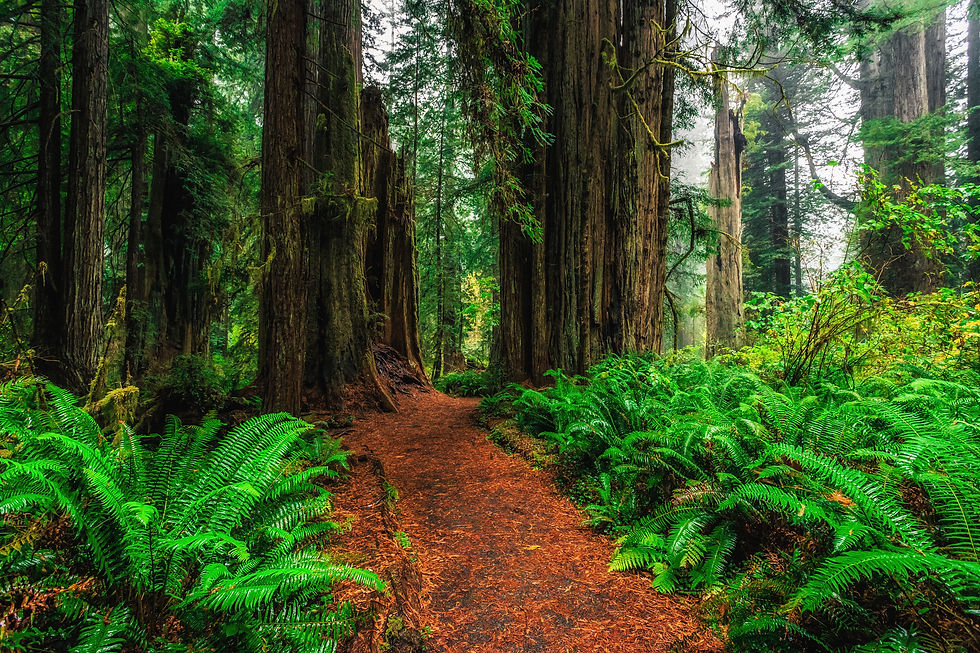
Together, these trails reveal that Sequoia and Kings Canyon are not simply parks of giant trees. They are among the most geologically and ecologically diverse protected landscapes in the United States.
A Legacy Worth Protecting
Every trail in Sequoia and Kings Canyon also tells the story of the people who fought to preserve these forests.
Long before the parks were established, Indigenous communities lived throughout these mountains, developing an intimate understanding of the land over thousands of years. They used carefully managed fire to maintain healthy forests, improve wildlife habitat, and encourage the growth of important food plants. Modern research has shown that these traditional practices played an important role in shaping the open forests visitors enjoy today.
The giant sequoias later faced another threat as commercial logging expanded across California during the nineteenth century. Although many forests were harvested, the extraordinary size and brittle wood of the sequoias made large-scale logging less practical than many entrepreneurs expected. At the same time, growing public appreciation for these remarkable trees inspired early conservation efforts that ultimately led President Benjamin Harrison to establish Sequoia National Park in 1890, making it the nation's second national park.
Visitors hiking these trails today are benefiting from more than a century of conservation work. Every footpath, scenic overlook, and preserved grove reflects the efforts of people who recognized that these forests were too extraordinary to lose.
In the next section, we'll explore the best Sequoia Kings Canyon hikes, from easy walks beneath the world's largest trees to unforgettable climbs that reward hikers with some of the finest views in the Sierra Nevada.
The Best Sequoia Kings Canyon Hikes
One of the reasons hikers return to Sequoia and Kings Canyon year after year is the remarkable variety of trails found within the two parks. Some paths lead beneath the largest trees on Earth, while others climb granite domes, follow glacier-fed rivers, or reward visitors with sweeping views across the Sierra Nevada. Together, they showcase the incredible diversity of landscapes protected within these neighboring national parks.
Whether you have an hour to spare or an entire day to explore, these hikes offer some of the most memorable experiences in California.
General Sherman Tree and the Congress Trail
No hike better introduces visitors to Sequoia National Park than the walk to the General Sherman Tree, the largest living organism on Earth by volume.
From the upper parking area, a paved trail descends about a quarter mile to the base of this remarkable giant. Standing beneath General Sherman is an experience that photographs struggle to capture. Rising approximately 275 feet above the forest floor, with a trunk measuring 36 feet in diameter, the tree overwhelms the senses with its sheer scale. Many visitors instinctively tilt their heads back, only to realize they still cannot take in the entire tree at once. Its thick, cinnamon-colored bark feels surprisingly soft and fibrous, adding another unexpected detail to an already unforgettable encounter.

Rather than returning immediately to the parking area, continue onto the Congress Trail, one of the finest walks in the Giant Forest. This gentle, paved 2.7-mile loop winds through a remarkable grove of giant sequoias, allowing visitors to spend unhurried time among some of the oldest living trees on Earth.
Along the trail, you'll encounter several of the park's most celebrated trees. The towering McKinley Tree rises even taller than General Sherman, while the Lincoln Tree features a hollow opening large enough for visitors to step inside and look upward through its interior. Farther along, the tightly clustered Senate Group creates a canopy that resembles the vaulted ceiling of a grand cathedral, and the magnificent President Tree reminds hikers that this forest contains numerous giants whose stories are often overshadowed by General Sherman itself. The trail also passes Hale Tharp's Hollow Log, where one of the Giant Forest's earliest settlers once made his home inside a naturally hollowed sequoia.
Although the trail is relatively easy, allow at least two hours to fully appreciate the experience. This is not a hike to rush.
Tokopah Falls Trail
If the Giant Forest introduces visitors to the world's largest trees, the Tokopah Falls Trail reveals an entirely different side of Sequoia National Park.
Beginning near Lodgepole Campground, the trail follows the Marble Fork of the Kaweah River through a glacially carved valley surrounded by polished granite cliffs. Unlike the Giant Forest, this higher-elevation landscape contains very few sequoias, demonstrating how dramatically the park's ecosystems change with elevation.

The hike covers 3.4 miles round trip with approximately 600 feet of gradual elevation gain, making it accessible to most hikers with a moderate level of fitness. Throughout the walk, the river provides a constant soundtrack as it tumbles over boulders and through narrow channels carved by thousands of years of flowing water.
The destination is Tokopah Falls, a spectacular waterfall that plunges nearly 1,200 feet down a towering granite headwall at the end of Tokopah Valley. During late spring and early summer, when snowmelt feeds the falls, the cascade becomes one of the most impressive waterfalls in the Sierra Nevada. Patient hikers may also spot yellow-bellied marmots sunning themselves on nearby rocks, adding a memorable wildlife encounter to the journey.
Moro Rock
Few hikes deliver such dramatic rewards in such a short distance as Moro Rock.
This iconic granite dome rises prominently above the surrounding forest, and a historic stairway carved directly into the rock allows visitors to reach its summit. Built by park rangers in 1931, the route climbs 350 stone steps, gaining roughly 300 feet in elevation before reaching an observation platform perched at 6,725 feet above sea level.
The ascent is brief but unforgettable. As you climb, the forest gradually falls away, revealing increasingly expansive views of the Great Western Divide, the deep river canyons of the Sierra Nevada, and seemingly endless mountain ridges stretching toward the horizon. Guardrails provide security along much of the route, but the exposed granite and sweeping vistas create an exhilarating experience that feels far removed from the valley below.

On exceptionally clear days, hikers can see across vast sections of the Sierra Nevada, making Moro Rock one of the finest panoramic viewpoints in either national park.
Big Views Come in Many Forms
One of the most remarkable aspects of hiking in Sequoia and Kings Canyon is that every trail tells a different story.
The General Sherman and Congress Trail immerses visitors in an ancient forest where giant sequoias have quietly grown for thousands of years. Tokopah Falls demonstrates the immense power of glaciers that carved broad granite valleys before retreating at the end of the last Ice Age. Moro Rock reveals the vast scale of the Sierra Nevada from a summit reached by one of the park's most iconic stairways.
Together, these hikes illustrate why Sequoia and Kings Canyon are so much more than parks filled with giant trees. They are places where forests, rivers, mountains, and geological history come together to create one of the most rewarding hiking destinations in the United States.

In the next section, we'll explore several lesser-known hikes that offer equally rewarding experiences while revealing fascinating stories about the forests, wildlife, and conservation efforts that continue to shape these extraordinary parks.
Tips for Hiking in Sequoia and Kings Canyon National Parks
A little preparation can make your hiking experience both safer and more enjoyable.
To get the most from your visit:
Start popular hikes such as General Sherman, Moro Rock, and Tokopah Falls early in the morning to avoid crowds.
Carry more water than you think you will need, especially during summer when temperatures can rise quickly.
Remember that many trailheads begin above 6,000 feet, so allow time to adjust to the elevation before attempting more strenuous hikes.
Wear sturdy hiking shoes with good traction, as granite surfaces can become slippery when wet.
Stay on designated trails to protect fragile vegetation and shallow sequoia root systems.
Watch for wildlife from a respectful distance and never feed wild animals.
Check current trail conditions before setting out, particularly after storms or wildfire activity.

Above all, allow yourself time to slow down. These parks reward visitors who pause to notice the details, whether it is the texture of a sequoia's bark, the sound of a mountain stream, or the changing light filtering through an ancient forest.
Download the Sequoia & Kings Canyon Driving Tour
The hiking trails reveal the beauty of Sequoia and Kings Canyon National Parks, but they tell only part of the story. Behind every giant tree, granite dome, waterfall, and mountain overlook lies a fascinating history that many visitors never discover on their own.
The Sequoia & Kings Canyon Driving Tour transforms your visit into a fully guided adventure with GPS-triggered narration that plays automatically as you travel through the parks. Along the way, you'll learn why giant sequoias depend on wildfire to survive, hear the remarkable story of Colonel Charles Young and the Buffalo Soldiers, discover hidden groves beyond the busiest stops, and uncover the geological forces that created the towering granite cliffs, deep river canyons, and ancient forests surrounding you. The tour also guides you to the parks' best hikes, scenic viewpoints, and lesser-known stops, allowing you to explore at your own pace while never missing the stories that make these landscapes unforgettable. Whether you have a single day or an extended stay, the Sequoia & Kings Canyon Driving Tour helps you experience these remarkable national parks with deeper insight and a greater appreciation for the landscapes around you.
Download the Sequoia & Kings Canyon Driving Tour today and discover the stories, history, hidden trails, and unforgettable viewpoints that turn every mile into an adventure.


Comments