
What To See In Gettysburg: A Guide To The Places That Still Tell The Story
- Zach Villaver
- Jul 20
- 5 min read

Updated: Jul 22
Gettysburg is a small Pennsylvania college town where the Civil War turned, and where 51,000 men were killed, wounded, or captured over three days in July 1863. It looks peaceful now—rolling fields, wooded ridges, church steeples—but almost every quiet view here hides a decision, a mistake, or a moment of courage that changed the course of the war.

If you are wondering what to see in Gettysburg, think in layers: the ground where the battle unfolded, the places where leaders made their choices, and the sites where the country tried to make sense of it afterward. You can walk it, drive it, or listen as you go—but the more of that ground you touch, the clearer the story becomes.
Start At The Visitor Center And Cyclorama
Begin at the Gettysburg National Military Park Visitor Center on Baltimore Pike. Inside you will find orientation exhibits, a museum that lays out the war and the campaign, restrooms, water, and maps—everything you need before you try to understand the battlefield itself.

Do not skip the Cyclorama: a 360-degree painting of Pickett’s Charge completed in 1883 that immerses you in the final assault of the battle. It is one of the most striking pieces of Civil War art in the country and helps you visualize how 12,000 Confederate soldiers crossed a mile of open field toward Cemetery Ridge on July 3.
Walk The Ground On Culp’s Hill And At Spangler’s Spring
From the Visitor Center, head to Culp’s Hill—the right anchor of the Union “fishhook” line and the most defensible ground on the battlefield. The 60-foot observation tower there gives you a rare 360-degree view where the geometry of the battle finally clicks: the Baltimore Pike below, Cemetery Hill to the west, and the approach routes Confederate troops used to attack.

Just down the slope lies Spangler’s Spring, one of the most quietly powerful places in Gettysburg. On the night of July 2, Union and Confederate soldiers slipped down here in the dark to share water in silence, then went back to their own lines to continue killing each other the next day. Standing by the spring, you feel both the shared humanity and the brutality compressed into a single meadow.
Climb Little Round Top And Look Across Devil’s Den
Little Round Top is one of the essential things to see in Gettysburg. Park at the base, walk the short trail, and stand on the rocky crest where Union troops rushed into position on July 2 to keep the left flank from collapsing. From the top, you can look down over Devil’s Den, the Wheatfield, the Peach Orchard, and the long open ground between Seminary Ridge and Cemetery Ridge.

This view is a tactical panorama: every ridge, wall, and boulder mattered as thousands of men tried to hold or take this height. If you bring binoculars, you can trace the exact routes attacking Confederate brigades climbed and understand why this hill became the hinge on which the second day of the battle turned.
Visit Lee’s Headquarters On Seminary Ridge
On Seminary Ridge, a modest stone house built in 1833—known as the Mary Thompson House—served as Robert E. Lee’s headquarters for all three days of the battle. From here, he coordinated the attack on Culp’s Hill, delayed Longstreet’s assault on July 2, and ordered Pickett’s Charge on July 3.

The house stands near the ridge that formed the Confederate spine of the battlefield, running roughly four miles north to south. When you walk this ground, you are moving through the space where Lee watched his army’s early successes and final disaster unfold in real time
Find The Human Stories: Buford, Reynolds, And John Burns
Gettysburg is not only about generals and maps; it is about choices made by specific people at specific moments.
At the statues of General John Buford and General John Reynolds, you stand where the Union accidentally won the first day. Buford, with fewer than three thousand cavalrymen, chose to hold the ridges west of town long enough for infantry to arrive, and Reynolds rushed his corps forward and was killed within fifteen minutes of reaching the field.

At the John Burns monument, you meet the most unlikely participant in the battle: a 69-year-old civilian who put on his coat, grabbed his musket, and fought alongside the Iron Brigade on July 1. He was wounded three times and survived by convincing Confederates he was just a sick old man caught in the crossfire.
These stops turn a massive battle into a human-scale story: one cavalry officer buying time, one corps commander dying at the front, one old man refusing to stay home.
Stand Above The Railroad Cut And At The Eternal Light Peace Memorial
The unfinished railroad cut north of town is an easy overlook with a brutal story packed into ten minutes. Confederate troops from Joseph Davis’s Mississippi brigade dropped into the trench thinking it was cover, only to find themselves trapped and flanked by Union soldiers who seized their flag and captured hundreds of men. The cut shows how terrain can instantly turn advantage into disaster.
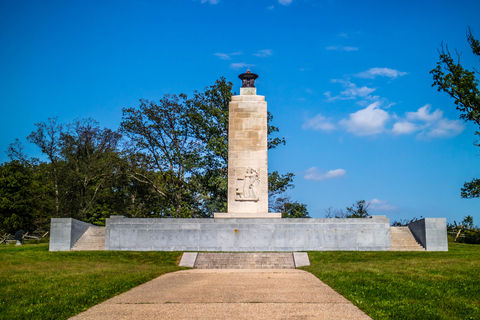
Not far away, on Oak Hill, the Eternal Light Peace Memorial marks the place where the country tried to heal. Dedicated in 1938 on the seventy-fifth anniversary of Pickett’s Charge, it brought together nearly 1,800 aging Union and Confederate veterans beneath a monument built from Maine granite and Alabama limestone—one Union state and one former Confederate state literally supporting the same structure. The flame there, inspired later the eternal flame at President Kennedy’s grave, is the only monument on the battlefield that uses the word “peace.”
End Your Day At The Soldiers’ National Cemetery
As evening comes, the Soldiers’ National Cemetery is one of the most powerful places to close your visit. More than 3,500 Union soldiers lie here in curved rows organized by state, along with hundreds of unknowns whose names were lost in the chaos after the battle.

Near the central monument is the spot where Abraham Lincoln spoke on November 19, 1863, delivering the brief address now known as the Gettysburg Address to a crowd of about 15,000 people. A famous orator spoke for two hours that day and is forgotten; Lincoln spoke for two minutes and reshaped the way the nation understood what had happened on these fields. Visiting at dusk, when the groups have gone and the light is low, makes the scale of sacrifice feel very close.
Bring The Battlefield To Life As You Drive
If you want to go beyond reading signs and trying to piece together monuments on your own, a GPS-aware audio driving tour can turn this landscape into a guided story. The “Battle of Gettysburg Driving Tour” is designed to play automatically as you move at driving speed, timing narration to each ridge, meadow, and crossroads so you can keep your hands on the wheel and your eyes on the road.

You will hear about the old man with a musket, the general who sent his own amputated leg to a museum, the brigade that charged knowing they probably would not return, and the dog who refused to leave wounded soldiers for three days. It is built to stop, get out, and walk key ground, not just glance at it through a windshield.
To experience Gettysburg with that level of storytelling—where each turn, ridge, and monument connects to the decisions and people behind it—download the Battle of Gettysburg Driving Tour It will guide you through the sites above and many more, tying together what to see in Gettysburg into one continuous narrative you can follow at your own pace.


Comments